From Robots to Production Lines: Why NPUs Are Emerging as the New Standard for Real-Time Industrial AI

The convergence of robotics and smart manufacturing
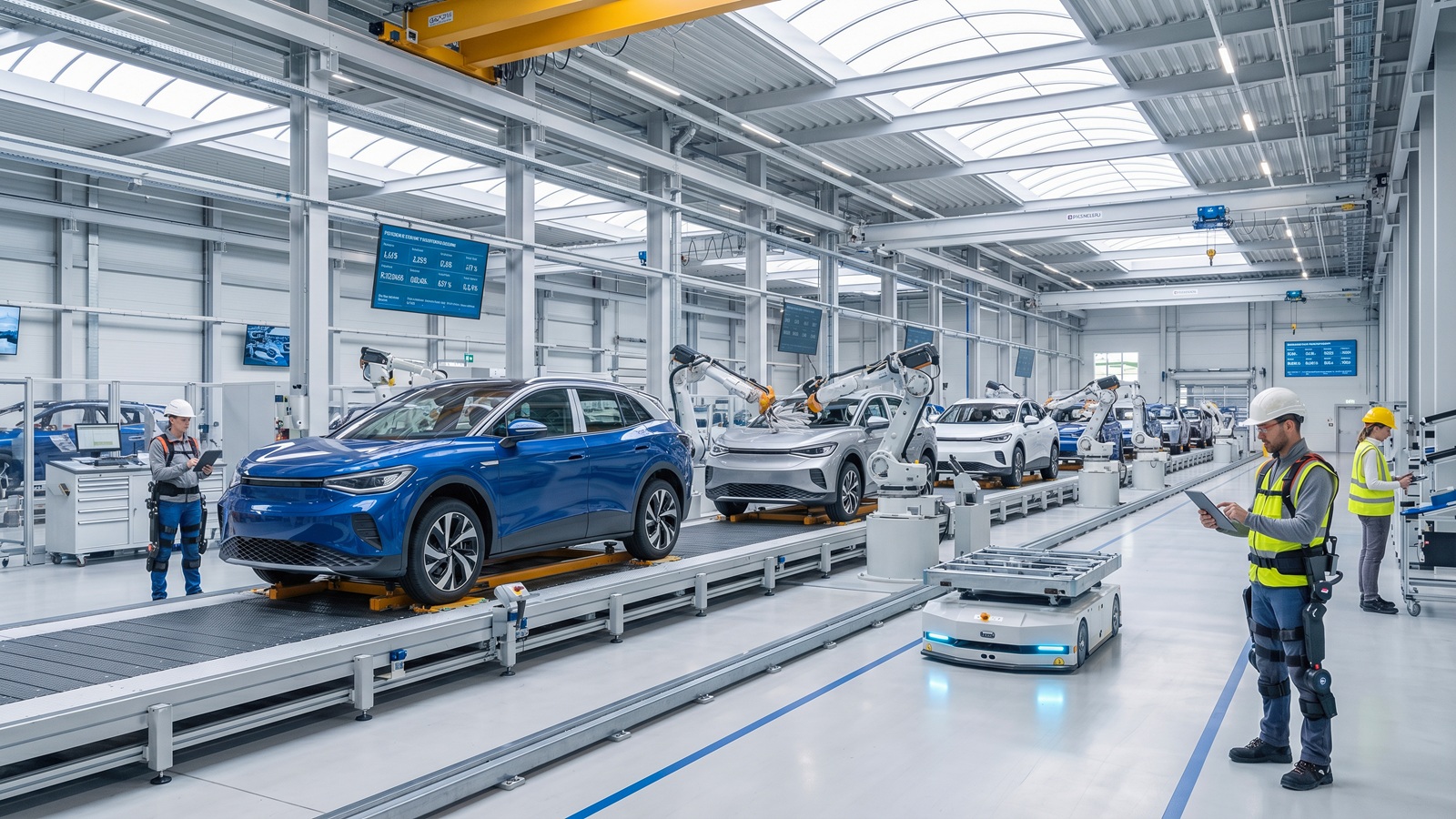
Industrial robotics and smart factories are increasingly being designed as unified cyber-physical systems. Production environments now depend on robots, machine vision systems, programmable logic controllers (PLCs), industrial PCs, and inspection platforms that work together under tightly defined timing requirements.
This has direct implications for industrial AI architecture. Vision, decision-making, and control all need to operate close to the machine layer, where systems can respond immediately to moving workpieces, production-line changes, or human interaction without introducing unnecessary network delay.
For engineering teams, the real challenge is embedding AI inference into the systems that already govern motion, inspection, and process control, rather than treating it as a separate processing layer.
Why conventional architectures struggle
Traditional cloud-centric AI architectures introduce latency and network dependency that are difficult to tolerate in industrial environments. Tasks such as defect detection, robotic path planning, and safety monitoring often require response times measured in milliseconds. Routing visual or sensor data to external servers introduces delays and potential failure points that are incompatible with real-time factory operations.
Conventional edge architectures often force engineers to make difficult trade-offs:
- Thermal complexity: GPU-based systems require higher power budgets and active cooling, introducing fans and larger thermal solutions that are vulnerable in dusty or high-vibration factory environments.
- Latency and determinism: Cloud-dependent systems can introduce jitter and network delays that disrupt the millisecond-level precision required for robotic path planning and closed-loop control.
- Scaling bottlenecks: As AI models grow in size and number, legacy systems quickly hit thermal limits, making it difficult to run concurrent workloads for detection, tracking, and safety on a single device.
How DX-M1 enables distributed industrial intelligence
At the heart of this approach are specialised Neural Processing Units (NPUs) such as DEEPX’s DX-M1, figure 1. Architected for high-efficiency throughput, the DX-M1 delivers up to 25 TOPS (tera operations per second) within a low power envelope, typically under 5 W. This enables running multiple complex vision workloads locally while remaining within the strict power and thermal constraints of industrial hardware.
Its AI-optimised architecture allows multi-model inference to run directly inside robotic platforms, industrial PCs, and PLC-adjacent control systems. Vision-based tasks such as object detection, facial recognition, defect analysis, and motion tracking can be executed on-device, removing cloud dependency and reducing latency to the point where real-time machine response becomes practical.
The low-power characteristics of the DX-M1 also reduce heat generation, making fanless or sealed industrial designs more feasible. This is particularly important in production environments where dust, vibration, or elevated ambient temperatures make active cooling undesirable.
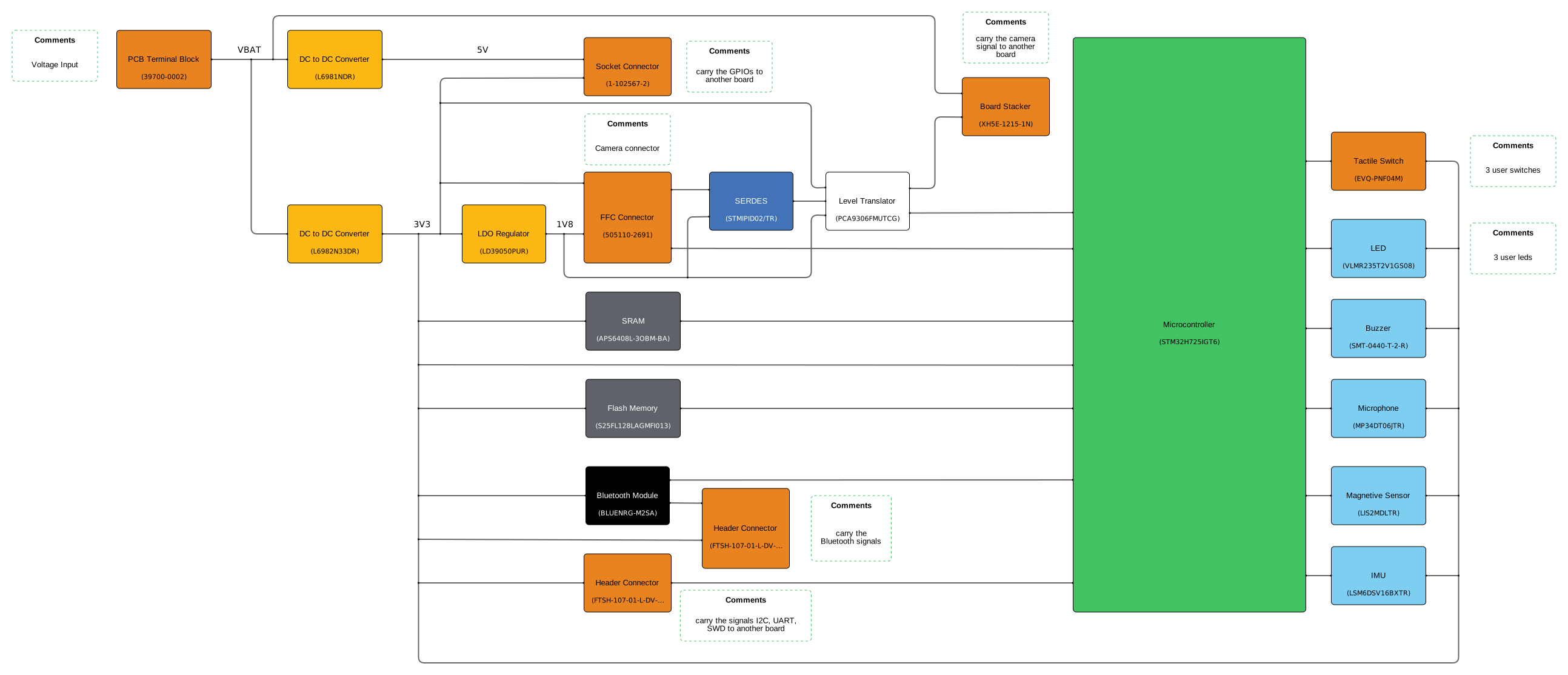
 (Click to enlarge) Figure 1: DEEPX DX-M1 architecture and performance profile, illustrating up to 25 TOPS of AI throughput within a sub-5 W power envelope for industrial edge inference.
By bringing inference directly next to the control layer, NPUs such as the DX-M1 allow perception and control to operate as part of the same machine-level system rather than as loosely connected subsystems.
Hyundai-Kia Robotics Lab: multi-model vision at the edge
A recent project from Hyundai-Kia’s Robotics Lab illustrates how these architectures are applied in practice. Service and patrol robots developed by the lab rely on multiple simultaneous vision AI functions, including face identification, masked-face recognition, gesture analysis, action recognition, pose estimation, and object detection.
Running these models together inside a mobile robotic platform places significant demands on local compute resources, particularly where power, size, and battery life are tightly constrained. Traditional GPU-based approaches can quickly become impractical because higher power draw reduces operating time and increases thermal complexity.
By integrating low-power DEEPX NPU architectures, including devices such as the DX-M1, these robotic systems can execute multiple vision models concurrently while preserving battery life and maintaining real-time responsiveness. This enables robots to navigate dynamic environments, interact safely with people, and continue operating in areas where cloud connectivity may be inconsistent, such as elevators, corridors, and industrial interiors.
The result is a more capable robotic platform in which perception remains tightly coupled to movement and interaction.
POSCO DX: integrating inference directly into industrial control
A second example comes from smart manufacturing, where POSCO DX’s integrated PLC and AI controller architecture shows how AI inference is moving directly into industrial control systems, figure 2.
In conventional factory architectures, machine vision inference and PLC control often reside on separate systems, exchanging data over a network. Even when network latency is low, this separation introduces communication overhead and additional failure points.
By integrating the DX-M1 directly alongside programmable control within platforms such as POSCO DX’s PosMaster industrial control system, inference and control can operate within the same unit. Vision-based inspection, anomaly detection, and process monitoring can therefore feed directly into machine logic without relying on inter-device communication.
This architecture improves determinism and system stability while reducing the engineering complexity of deployment. It also supports more compact intelligent controllers that can be deployed across multiple production cells, allowing manufacturers to scale AI-driven monitoring and optimisation more efficiently.
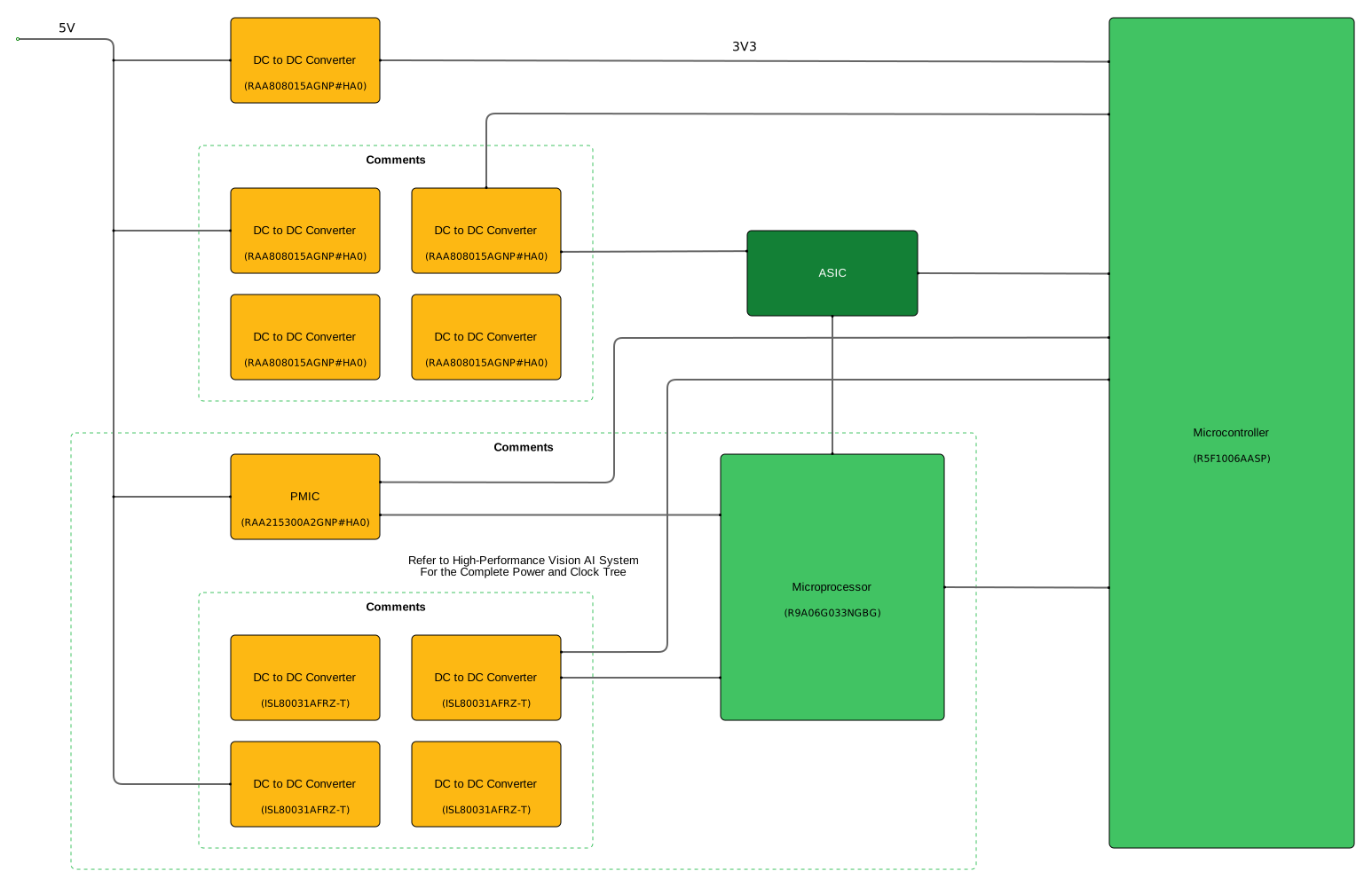
 (Click to enlarge) Figure 2: POSCO DX’s PosMaster control architecture, illustrating how AI inference can be integrated directly alongside PLC logic for deterministic real-time factory control.
(Source: https://www.poscodx.com/eng/solution/posMaster)
For factories moving toward autonomous adjustment and closed-loop optimisation, this tight integration between AI inference and control is increasingly valuable
Industrial PCs and scalable production-line intelligence
The same architectural model extends naturally into industrial PCs and machine-level edge systems. Platforms developed for smart manufacturing increasingly integrate AI inference directly into industrial PCs, allowing inspection, monitoring, and analytics workloads to be embedded within existing line infrastructure.
Here, the DX-M1’s compact form factor and low thermal footprint make it easier to integrate AI into systems that must fit inside constrained control cabinets or machine housings. Multiple production-line tasks, such as defect detection, barcode verification, and predictive maintenance analytics, can be distributed across line-side systems rather than centralised.
This distributed approach improves resilience and simplifies scaling. Intelligence can be added incrementally across individual machines, workstations, or cells, reducing dependence on central servers and allowing manufacturers to expand AI capability in line with operational priorities.
From silicon to deployable industrial systems
For OEMs and industrial system designers, choosing the NPU is only the starting point. The bigger task is integrating it into a production-ready architecture that can meet latency, thermal, lifecycle, and scalability targets.
This is where the DEEPX–Avnet Silica collaboration adds practical value. Access to the DX-M1 is only the starting point; the greater opportunity lies in helping engineering teams integrate that capability into production-ready robotics, PLC, and industrial PC architectures. Workload partitioning, memory, and thermal design can then be aligned with the wider system requirements of the target application.
Avnet Silica’s role in supplier access, ecosystem alignment, and engineering support helps reduce the path from proof-of-concept to production deployment. For OEMs and industrial system designers, this makes it easier to move from isolated AI demonstrations to robust, scalable machine intelligence deployed directly inside operational systems.
Crucially, the hardware is supported by a comprehensive software toolchain that simplifies the transition from model development to deployment. Support for standard frameworks such as ONNX, TensorFlow, and PyTorch allows engineering teams to port existing AI models to the edge without rebuilding their software stack from scratch.
Conclusion
As robotics and smart manufacturing continue to converge, the value of AI increasingly depends on where inference takes place. Systems that rely on remote processing or loosely coupled architectures can fall short of the real-time and reliability requirements of industrial environments.
Low-power NPUs such as the DX-M1 enable a different model, in which perception, decision-making, and control operate together at machine level. From robotics platforms to PLC-integrated controllers and industrial PCs, this makes real-time distributed intelligence practical within the physical constraints of production environments.
The result is a more scalable path toward intelligent factories, where AI is embedded directly into the systems that sense, decide, and act.
Hardware Solutions for AI
Understanding the unique opportunities and hardware challenges across different deployment tiers is essential for designing impactful AI systems that meet the demands of modern applications.