From Connected Devices to Physical AI: How IoT Became the Foundation for Intelligent Systems


In 2012, the International Telecommunication Union defined the Internet of Things (IoT) as an infrastructure that enables advanced services, with devices combining communication capabilities with sensing, data capture, processing, and actuation. The objective was not simply to put products online, but to use connected data to make physical systems more visible, responsive, and ultimately more intelligent across homes and industries.
The first waves of deployment succeeded at connecting the physical world but also exposed the limits of connectivity alone. Sensors could report a temperature change, cameras could stream images, and machinery could signal faults, yet converting those observations into an appropriate response still depended heavily on fixed rules, cloud platforms, or human interpretation.
That gap now defines the next phase of IoT. AI is providing the interpretation layer, while edge AI is bringing selected inference workloads closer to the data source. Physical AI takes this further by using those outputs to influence the real world. As each stage adds capability, it also makes the relationship between the model, data path, hardware, and wider system architecture more consequential.
From Smart Devices to Fragmented Intelligence
Since 2012, sensors, wireless connectivity, and embedded processing have become smaller, cheaper, and more efficient, helping IoT expand rapidly. By the end of 2025, IoT Analytics estimated that there were 21.1 billion active connected IoT devices worldwide, excluding computers, mobile phones, and consumer tablets.
This growth has delivered enormous volumes of useful data but not necessarily joined-up intelligence. Many products have been built around their own applications, cloud platforms, and, in some cases, communication protocols. They could sense, communicate, and occasionally link triggers to provide a form of ‘smart’ operation, but they rarely understood the wider context in which an event occurred.
This fragmentation was partly a consequence of engineering reality. Early IoT endpoints were designed around tight limits on processing performance, memory, power, and communication bandwidth. Their primary role was to capture data reliably and send it elsewhere, leaving analysis to a gateway, cloud platform, or operator.
Products were also typically developed to solve one defined problem, so their software, interfaces, and data models grew around individual applications rather than as part of a wider system. Even at the cloud level, data often remained confined to separate vendor platforms or application environments, making it difficult to integrate information across the broader system.
 (Click to enlarge) Figure 1: Growth prediction of the Global IoT Market (Source: IoT Analytics)
This mattered because operational meaning often lies in the relationship between inputs. A change in temperature may be routine or an early warning depending on the equipment load, ambient conditions, vibration, and recent operating history. When those inputs remain in separate systems, the context needed to distinguish between the two is lost. The first IoT wave created a rich sensing and communications fabric, but much of the intelligence still sat outside it.
AI and Edge AI Are Turning IoT Data Into Decisions
Cloud-based AI has shown what is possible when connected data can be analysed in context. However, cloud AI also placed a network between an event and its interpretation. That is manageable for long-term energy analysis or fleet-wide optimisation, but less suitable when a camera must recognise an obstruction, a safety system must detect a person, or a machine must respond while the event is still unfolding. Connectivity then becomes part of the response path, introducing variable latency and the possibility that inference becomes unavailable when the link is degraded or lost.
Bandwidth creates another practical limit. A single uncompressed 3840 × 2160 RGB video stream running at 30 frames per second represents almost 6 Gbit/s of data before transmission overheads. Processing it locally can allow a vision system to send an alert, classification, or other relevant result instead of continuously transferring every frame.
Advances in embedded processors, neural processing units (NPUs), memory, and model optimisation have made more capable inference practical at the edge. Quantisation can reduce model size and memory traffic, while dedicated accelerators can execute supported neural-network operations more efficiently than general-purpose processing alone. The result is not simply cloud AI running on a smaller computer. It is an architecture in which immediate perception can happen locally, while training, fleet-level analysis, and model management remain distributed between the edge and cloud.
This changes the role of the IoT endpoint. Instead of only collecting and forwarding data, it can serve as a local decision point, converting sensor inputs into information the wider system can use immediately.
Physical AI Extends the Opportunity
While physical AI is most visibly associated with robots, drones, and autonomous vehicles, its development is closely linked to IoT. Connected sensing allows systems to observe the physical world, edge AI can generate a local estimate of the system state, and physical AI uses that estimate to select an action.
In the home, this could mean fusing occupancy, environmental, security, and energy data to coordinate heating, lighting, or access around inferred activity. In an industrial workcell, machinery could combine vision, encoder, and force data to estimate the position of a misaligned component and correct its trajectory or grip. The same progression extends into infrastructure, mobility, rehabilitation, logistics, and inspection.
When an AI decision can quickly affect people, equipment, or safety, the engineering stakes rise. Establishing the system state accurately may require heterogeneous sensing, with complementary inputs calibrated and time-synchronised before inference. This increases input/output and memory bandwidth requirements, can significantly increase model complexity, and may require low-latency communication with other systems to verify changing conditions.
AI outputs must also pass predictably into deterministic control and independent safety functions. The sensing architecture determines the data load, the model shapes, compute and memory requirements, and the required response time, which affects how inference, communications, and control are partitioned.
Why the Hardware Stack Becomes More Important
Adding AI changes an IoT product’s hardware requirements before it ever reaches physical actuation. The sensor modality and data rate affect acquisition and preprocessing, while the model graph and numerical precision determine accelerator compatibility, runtime memory, and bandwidth requirements. Where the result is needed influences how processing is divided between the device, nearby infrastructure, and cloud.
None of these choices exists in isolation. Nor is there a single entry point. A team may have an established IoT platform that needs more local intelligence, an AI model searching for deployable hardware, or a sensing application that has not yet defined its processing architecture.
Avnet Silica’s experts can engage from any of these positions, helping engineers understand the interplay between models and candidate platforms, identifying potential bottlenecks, and validating how the hardware, software, and data path behave together.
Hardware Routes to More Intelligent IoT
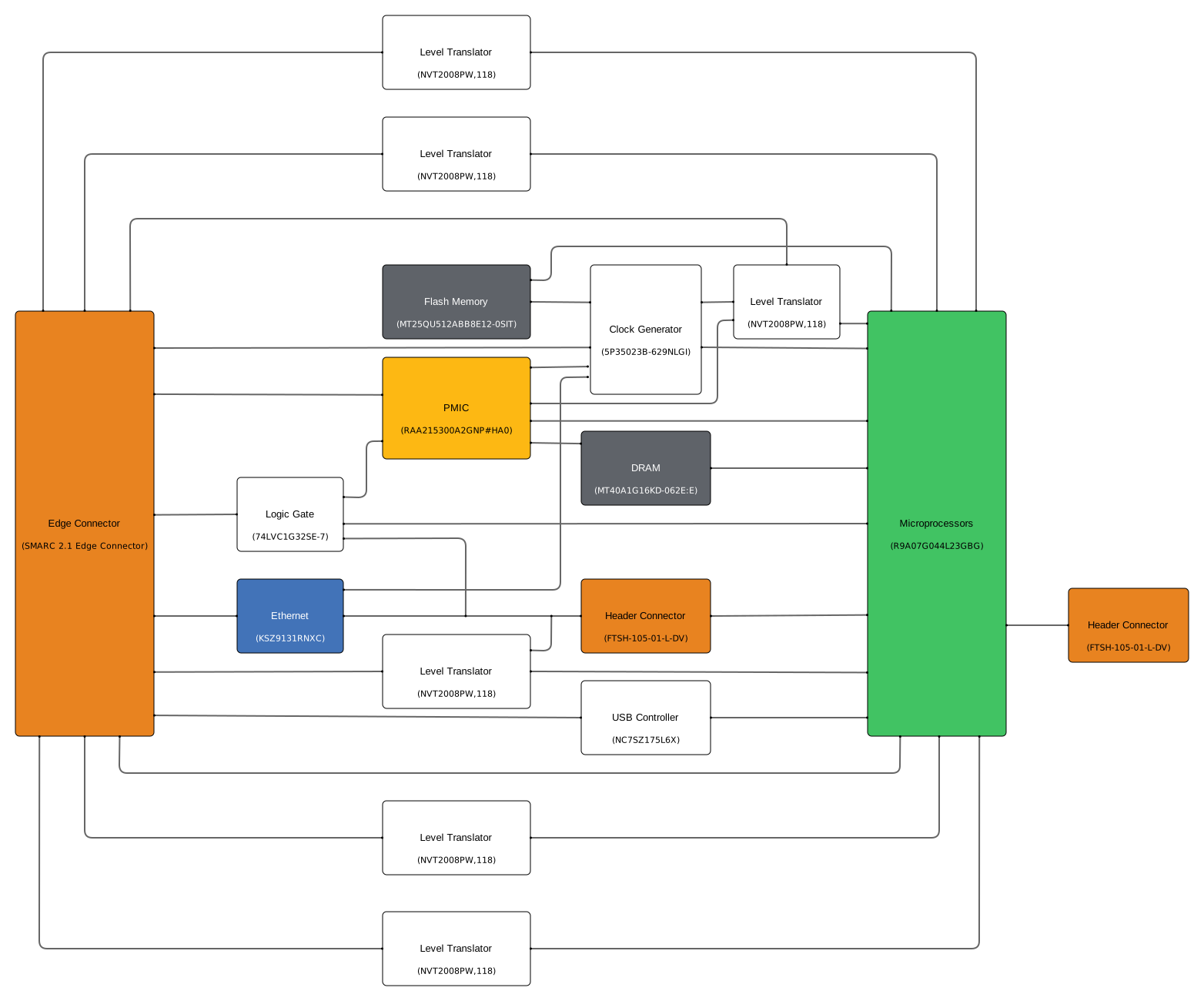
However, in terms of hardware, the OSM-LF-IMX95 module from Tria Technologies, an Avnet company, illustrates how IoT hardware is evolving to support this expanding role. It is suited to edge AI applications such as predictive maintenance, object classification, and production-line monitoring, where connected equipment must increasingly analyse data rather than simply transmit it. Its integrated image signal processor and NPU support local vision inference, while up to six Arm Cortex-A55 cores and separate Cortex-M7 and Cortex-M33 cores allow application software, communications, and real-time functions to be handled within the same platform.
Up to 16 GB of LPDDR5 memory with inline error correction provides headroom for larger or multiple models, while camera, CAN-FD, and Ethernet interfaces connect the platform to existing sensors, equipment, and IoT networks. The integrated EdgeLock Secure Enclave supports secure boot, provisioning, runtime attestation, and over-the-air updates, which become particularly important when software and AI models must be managed securely across a deployed fleet.
 Figure 2: Back side of TRIA OSM-LF-IMX95
Where an existing IoT platform already has suitable host processing, dedicated acceleration may provide a more direct upgrade path. The DEEPX DX-M1, for example, can add local vision inference to equipment such as smart cameras and edge gateways without requiring the complete processing architecture to be replaced. It provides up to 25 tera operations per second within a stated 2 to 5 W power range, allowing more capable models to be introduced where power and thermal headroom remain limited.
These examples represent only part of Avnet Silica’s reach across IoT, which extends from embedded components to complete system platforms. Its work with Microsoft adds another layer, bringing Windows IoT to the device, along with edge and Azure services, for industrial systems that may need to operate, evolve, and remain secure for many years.
Conclusion: Building Intelligent Systems
The progression from IoT to physical AI is an accumulation of capabilities. IoT established sensing and connectivity; AI made the resulting data meaningful; edge AI brought interpretation closer to the event; and physical AI is beginning to close the loop through action.
Each step also adds engineering interdependencies. Avnet Silica can support teams wherever they enter that process, helping align the model, data path, processing, memory, connectivity, control, security, and production strategy needed to turn a connected concept into a deployable intelligent system.
Hardware Solutions for AI
Understanding the unique opportunities and hardware challenges across different deployment tiers is essential for designing impactful AI systems that meet the demands of modern applications.