
€82M for European Solar Startups as Investment Stabilises in 2026
Useful jump links:
After dropping from an all-time high of €285M in 2023 to a decade low of €24M in 2025, venture capital investment in solar hardware and software startups in Europe has stabilised in 2026, with €82M in disclosed equity funding flowing into the sector so far this year.
New analysis of Crunchbase data by Avnet Silica reveals investors are still willing to make significant bets on European solar, but they’re more selective in the opportunities they pursue.
The study tracked venture capital activity for startups involved in the development of solar hardware and software across the full product lifecycle, from materials, cells and modules through to energy management and end-of-life recycling.

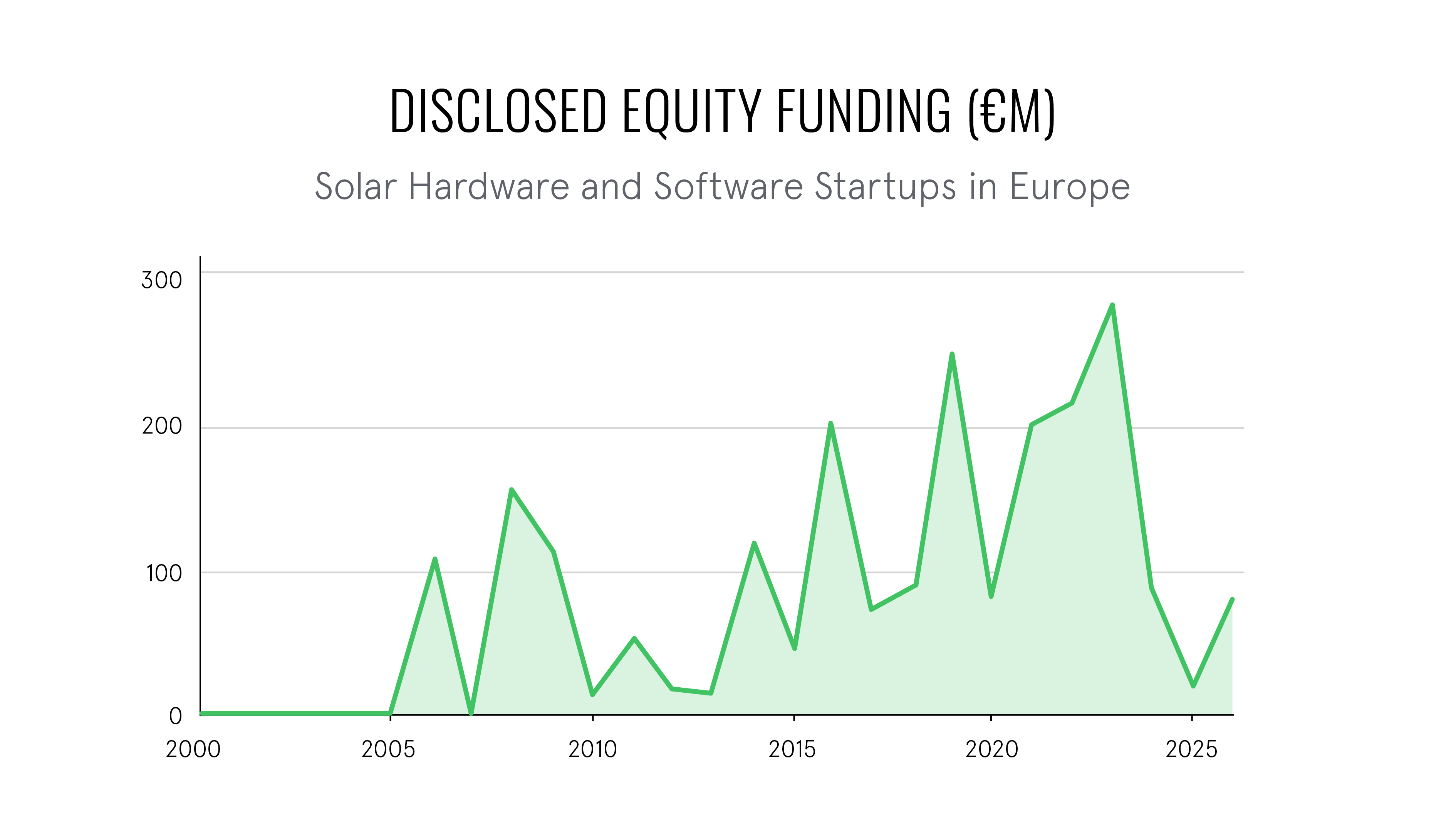
Image: Avnet Silica
While billions continue to flow into utility-scale solar projects, the level of startup investment offers a different perspective, showing where capital is actively funding the next generation of hardware and software innovation in Europe.
Majority of Solar VC Funding Goes to Early-Stage Startups
93% of the €82M received by European solar startups this year has gone to early-stage companies. With five deals over €10M already, 2026 is the joint highest year on record for large early-stage transactions.
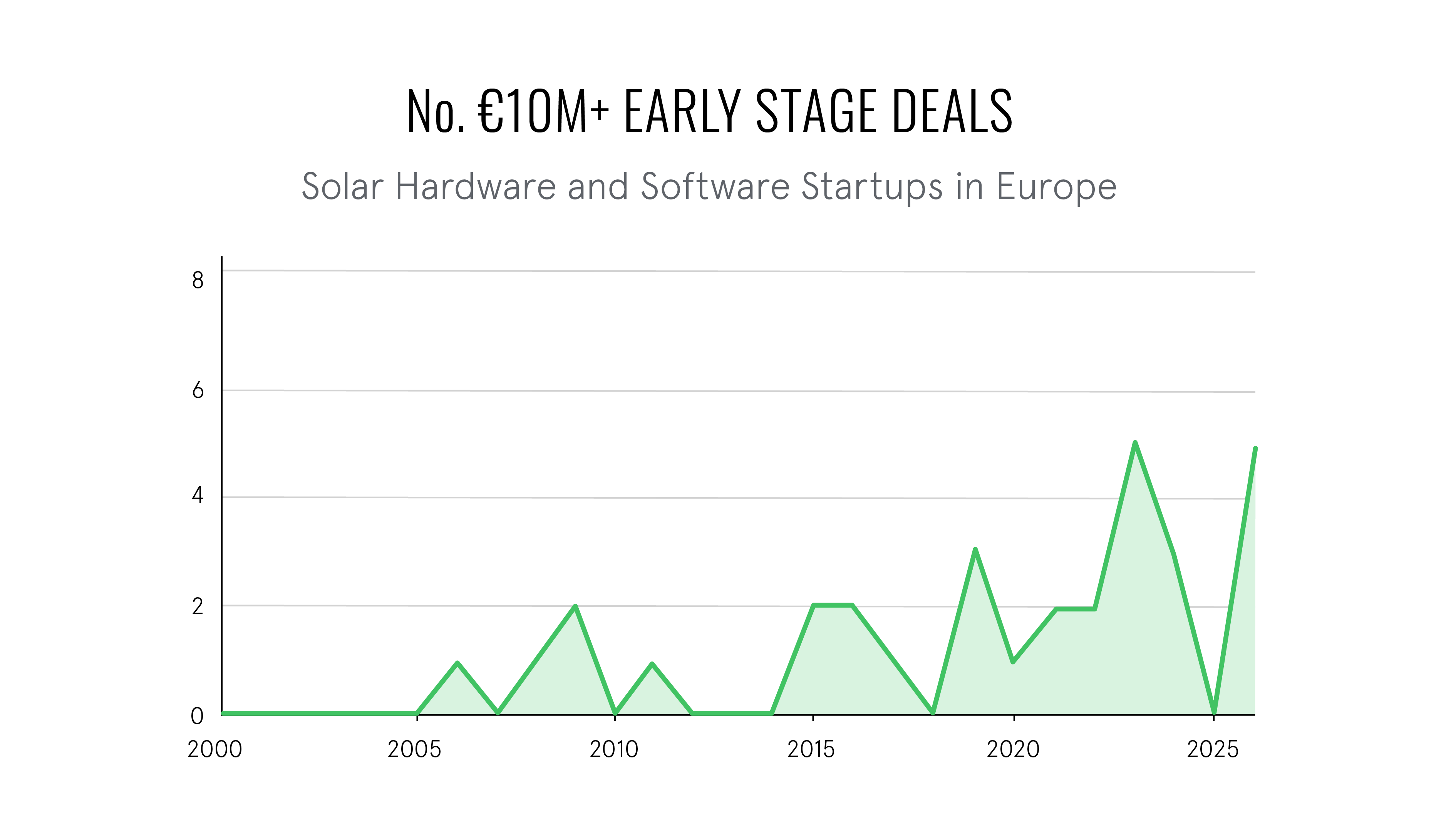
Image: Avnet Silica
Emerging Markets & Technologies
At the Pulse of the Market
We're always at the pulse of the market. Explore the trends shaping real innovation: AI, Automotive and ADAS, 5G, Renewables, and more. Act sooner, design smarter, and stay ahead of the curve.
Startup support
Tech/Electronic startup looking for support?
At Avnet Silica, we believe that every great innovation starts with a bold idea and a trusted partner. That’s why we’ve created a dedicated initiative to support electronics startups on their journey from concept to market-ready product.
The median funding round across all stages for European solar startups is the highest it's been in over 15 years at €15M. This is a result of venture capitalists focusing on a small number of substantial investments rather than spreading their bets across the sector, as seen in previous periods of more widespread growth.
Investors have largely retreated from the extremes of the investment spectrum, avoiding unproven seed concepts at one end and the heavy capital demands of late-stage growth at the other. Instead, they’re concentrating their capital on select early-stage opportunities that offer a balance of validated technology and upside potential.
Mergers and Acquisitions Rise as Larger Firms Consolidate Across the Solar Value Chain
There have been four mergers and acquisitions involving European solar hardware and software startups in 2026 so far, already making it the second-highest year on record, just behind 2021, which saw six acquisitions.
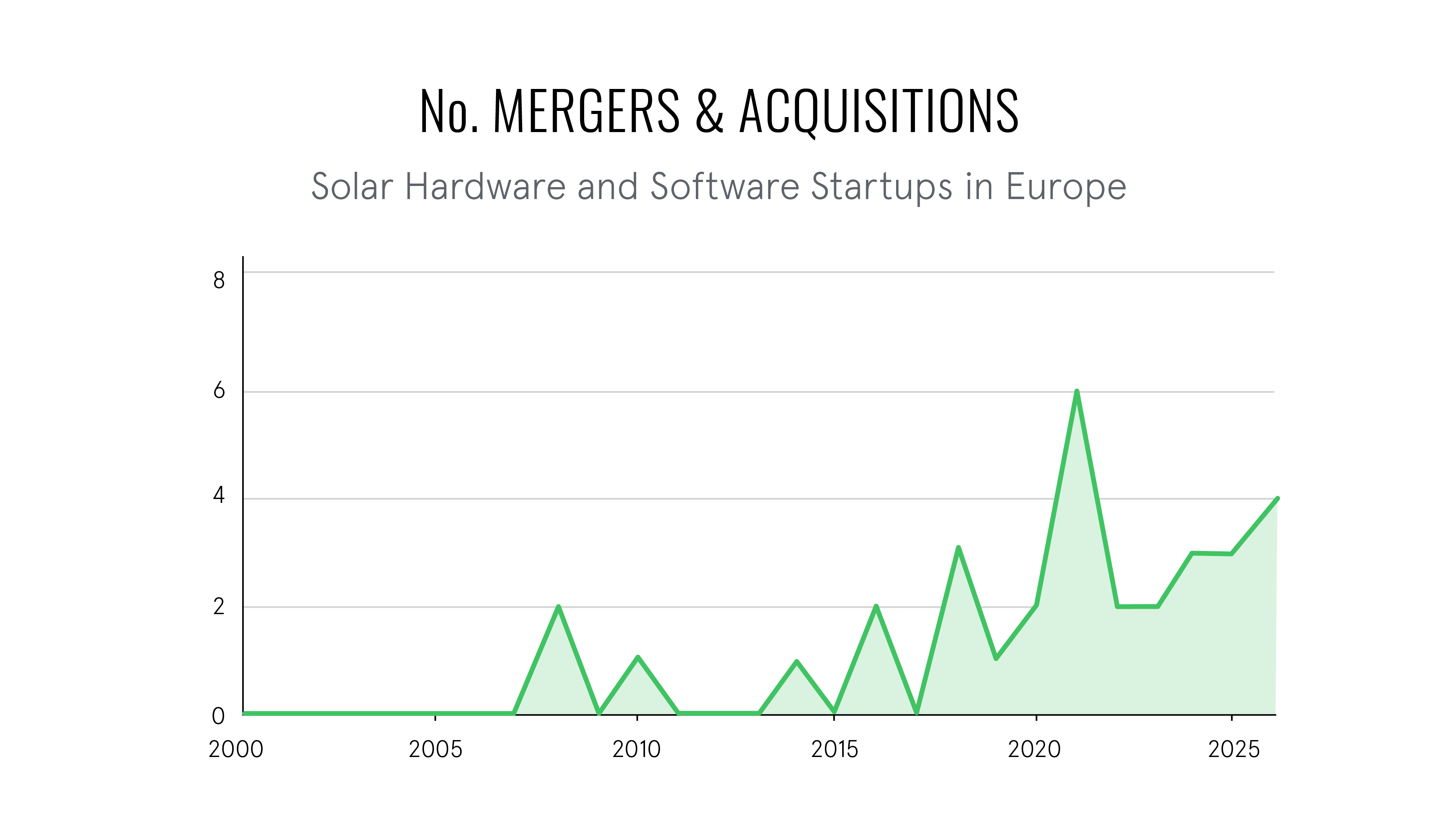
Image: Avnet Silica
With investors becoming more selective, corporate acquisitions offer an alternative pathway for financing and scaling company growth. M&A activity also allows larger organisations to consolidate their offering across the solar value chain.
Sunotec Group, for example, took a majority stake in Germany’s Kaufmann Electric in June 2026 to help ease grid connection bottlenecks and accelerate infrastructure delivery within their solar park construction business. By absorbing Kaufmann’s core offering of substations, solar cables, and energy connectors, Sunotec successfully moved a critical part of its supply chain in-house.
Capital Flows to Solar Startups Solving Friction in the System
While the solar industry has largely mastered mass production of low-cost PV modules, the sector is now facing second-order challenges such as grid connection bottlenecks, spatial constraints, and supply chain vulnerabilities.
A closer look at large European funding rounds, mergers and acquisitions in 2026 reveals capital is flowing into companies aiming to solve the friction points within the current system:
-
Utility-Scale Connection & Project Deployment: Sunotec’s strategic acquisition of Kaufmann Electric secures cables, connectors and substation engineering within their EPC ecosystem, helping them mitigate grid-connection delays and protect their deployment pipelines.
-
Load-Bearing Commercial Rooftops: France’s Heliup secured €16M in funding for their lightweight panels that tackle the weight-bearing limitations of commercial buildings, opening up massive square footage of previously unusable rooftops.
-
Renewable Heat for Public Buildings: The UK’s Naked Energy secured €10.35M (£8.8M) for their hybrid solar technology that generates both heat and electricity. Their high-density tubes aim to maximise energy output on space-constrained roofs of high-demand public facilities like hospitals, schools, and leisure centres.
-
Residential Energy Estimations & Installation Pipeline: Dutch startup Solar Monkey merged with Swiss firm Eturnity to combine their calculation and quotation software, allowing residential installers to provide more accurate energy estimations, optimise home layouts, and accelerate sales pipelines.
-
Building Integration: Solar Capture Technologies (UK) was acquired out of administration by TMS Solar Solutions to secure vital scaling capital. The British startup's composite BIPV roof tiles help bypass local planning restrictions and consumer resistance to traditional rooftop mounting.
-
Seasonality & Intermittent Power: Norway’s Photoncycle raised €15M to tackle one of the largest systemic flaws in Northern European solar—seasonality. The company’s home solar system with underground solid-state hydrogen storage transforms summer sun into year-round dispatchable power.
-
Recycling & Material Recovery: 43% of venture capital funding for European solar in 2026 went to material recycling and recovery firms. Germany’s Solar Materials and France’s ROSI secured €15M and €20M, respectively, indicating investors have their eye on upcoming solar waste liabilities and raw material constraints.
The Next Wave of European Solar Innovation
The current venture capital market in Europe can be characterised as a period of stabilisation following the boom of 2022–23 and the fall of 2024–25, with capital concentrated in a few select companies and consolidation across the value chain through increased mergers and acquisitions. But where the next wave of innovation in Europe will come from remains an open question for the sector.
Reflecting on the findings, Harvey Wilson, Senior Manager Industrial Vertical Markets EMEA at Avnet Silica, comments:

“While investment in Europe’s solar hardware and software startups has slowed over the past couple of years, the market can change quickly; it may take only one or two significant shifts to create an entirely different picture.
The increased focus on Europe’s energy independence and changing legislation is one potential catalyst. Energy security goes far beyond the ability to generate power and reduce dependence on foreign imports; it means ensuring the security of the components, the supply chain, and the data being transmitted. With the Cyber Resilience Act coming into play, product developers must prioritise fully compliant, secure-by-design components to maintain the right to sell connected products in Europe. This shift could trigger a significant increase in domestic manufacturing and investment.
Beyond compliance, there are still companies in Europe doing extraordinary things with solar power. One example is making ultra-thin, flexible solar PV modules that can be wrapped around consumer products and used to power devices using indoor and ambient lighting. We are also seeing highly aesthetic vehicle-integrated and building-integrated photovoltaics being produced. These new developments in cells and modules mean solar-powered products and buildings can look stylish and attractive without compromising energy performance.
Material breakthroughs like these could prompt further waves of product innovation. In the same way we now have entire product categories powered by batteries – like digital books and e-bikes – where electronics weren’t previously involved at all, ambient solar could become widely adopted across a variety of industries.
While the race to manufacture cheap, standard PV modules is largely over, national energy security has become a top priority. The next wave of innovation could arrive as an answer to these policy challenges, or through the new applications made possible by technological breakthroughs in materials, cells, and modules.
Startup founders and investors are still finding opportunities to solve friction points within the current system, and the boundaries of where this technology can be applied will keep shifting as companies continue to explore what’s next for European solar.”
DATA SOURCES & METHODOLOGY
Source: All companies listed under solar energy in the Crunchbase dataset with headquarters in Europe, as at 31st August 2026.
Further research was conducted by visiting each company’s website, its profile on Crunchbase, its LinkedIn profile, and third-party news articles to provide more granular details on the product and service offerings of each business. This allowed further categorisation of the companies in the list into more specific classifications.
The data was filtered to only include companies specialising in solar energy, and not those offering a general product which serves the soar industry among many others, nor those offering a range of products where solar energy was not the primary focus of the company.
The analysis then focused on startups specialising in the development of solar energy hardware and software, including specialist offerings across the product lifecycle, from developing advanced materials and solar cells through to end of life recycling.
This involved excluding companies that are focused on, for example, energy and commodities trading, online marketplaces, project development, installation, operations and maintenance, consulting services, and other closely related products and services.
Disclosed equity funding includes seed, angel, VC, private equity and corporate funding rounds. It does not include equity crowdfunding. It also excludes grants, debt financing, IPO and post-IPO funding.
Where the stage of a funding round (e.g. seed, venture round A, B, C, etc) was not explicitly stated, this was determined by assessing the information within the full context of the dataset, including other funding rounds the company has received.
It’s worth noting there is often a time lag between recent events and the original dataset being populated. This is especially true of information about new companies being founded or receiving seed and early stage funding.

Wide Bandgap Technologies: SiC & GaN
SiC and GaN power semiconductors enable higher-efficiency solar inverters, reducing energy losses while increasing power density, switching speeds and system performance across solar PV installations.
High-Efficiency MOSFETs
MOSFETs are fundamental to solar PV systems, enabling efficient power switching and conversion in inverters, optimisers and charge controllers to maximise energy yield and system reliability.
High-Efficiency IGBTs
IGBTs are a key enabling technology in solar PV, delivering efficient high-power switching in inverters that convert solar energy into reliable electricity for homes, businesses and the grid.
Other Solar Energy resources
Powering Solar Energy - SiC Shines a Light on Solar Power
Worldwide electricity consumption is growing fast, expected to rise by circa 4% annually from now to 2027. Solar photovoltaic (PV) generation is forecast to provide about half of this extra electricity, driven by falling PV prices and the need for zero-emission power. Global solar PV capacity has already tripled from 2018 to 2023, reaching over 1,600 TWh. This trend is accelerating, with strong growth particularly in China, supported by the USA, the European Union and India, and is in line with what is needed for our planet to hit the target of Net Zero emissions by 2050.
Market Research
86% of New Wind Startups Focus On Software & Alternative Turbines
The share of European wind energy startups focused on conventional horizontal-axis turbines and components fell sharply, from 64% of companies founded between 1996-2000 to just 14% of those established between 2021-2025.
Market Research
European energy storage hardware startups raise €2.14B
Total equity funding for European startups in energy storage hardware has topped €2.14 billion. 46.7% of the 2.14 billion was raised in the last three years, and 84.4% in the last five, reveals research from Avnet Silica.
Market Research
BESS startups expand value proposition as competition grows
European startups manufacturing Battery Energy Storage Systems have acquired $331.8 million in equity funding, with 75% of the companies estimated to have reached a phase of commercial maturity, reveals new research from Avnet Silica.
Further insights
The Future of Energy Storage
Learn where the energy storage investment is flowing, future energy storage technologies and applications, sustainability/engineering considerations, and much more.