Trucking, IoT & AI: Delivering a Revolution
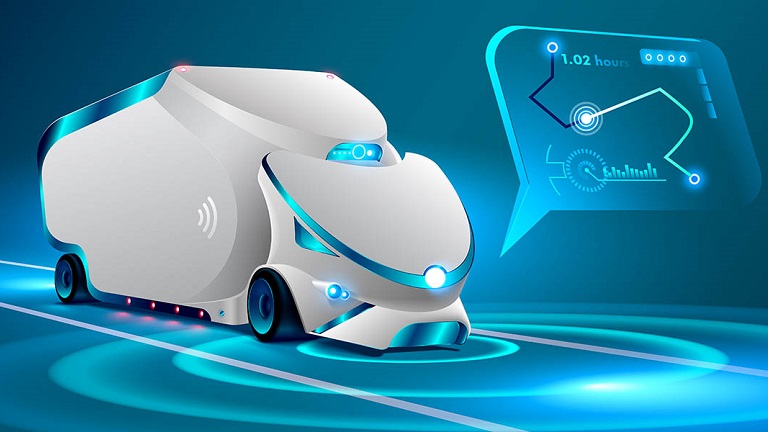
Artificial intelligence (AI), advanced robotics, and the Internet of Things are increasingly shaping the automotive and logistics sectors. Together, they are bringing greater intelligence and autonomy to the systems that plan, move and monitor freight, connecting what happens on the road to the people, warehouses and systems responsible for the wider operation. For fleets, the immediate value is not necessarily fully driverless trucks, but a clearer view of where delays, disruption or under-used capacity is beginning to build.
The trucking industry, and the logistics that keep it running, are fundamental to the success of supply chains, both nationally and internationally. Without those supply chains running smoothly, allowing for just-in-time orders and millions of successful daily deliveries, industries of all types would grind to a halt. In 2025, GB-registered heavy goods vehicles operating in the UK only carried 1.53 billion tonnes of domestic goods across 163 million journeys1.
While the acute driver shortage seen in 2021 has eased, driver availability still affects service levels. In the final quarter of 2025, 26% of UK heavy goods vehicle businesses reported driver vacancies2. Among those with vacancies, 23% had missed a delivery in the previous week because drivers were unavailable3. While connected systems cannot completely solve a staffing shortage, they can help fleets identify where pressure is building and make better use of the vehicles, people, and capacity available.

Heavy goods vehicle (HGV) businesses reporting UK HGV driver vacancies: quarterly from quarter 4 2021
Help Wanted: While the proportion of UK HGV businesses reporting driver vacancies fell from a high of 43% in Q4 2021, the figure has once again increased from 2024 to 25% in Q1 2026. Source: UK Gov Department for Transport.4
Time is of the Essence
Driver availability is far from the only pressure facing freight and haulage. Demand can shift quickly, while loading delays, traffic, and vehicle availability can all affect whether goods arrive as planned. Connected trucking has therefore moved well beyond a future concept. In September 2025, Volvo Trucks reported that more than one million of its vehicles were connected, using data from the trucks to support uptime, safety, and productivity5.
For fleet managers and truck owners, however, the challenge is not just collecting information but using it to understand what is happening across each vehicle, load, and journey in real-time. As trucks travel, connected sensors, electronic monitors, actuators, GPS receivers, radio-frequency identification (RFID) systems, and beacons can provide critical information about their location, condition, and performance. This gives decision-makers the insights needed to improve transparency, operational efficiency, and security, and ultimately protect margins.
Increasingly capable onboard processors mean that more of this data can also be analysed at the edge, within the truck or close to where it is generated. This supports faster responses without requiring every piece of information to be sent to a central platform. AI can then identify patterns across vehicle and fleet data, turning those inputs into insights that improve visibility, operational efficiency, and decision-making.
Together with robotics and wider connected infrastructure, these technologies are already helping the trucking industry respond to some of its most persistent problems. While fully autonomous long-haul trucking has not arrived at the scale once predicted, the same convergence of sensing, connectivity, and intelligence is changing how fleets operate today and providing the foundation for more automated functions in the future.
Here’s a closer look at how IoT and AI are transforming the trucking industry and supporting faster, safer, and more efficient logistics.
Safety First
One of the strongest arguments for introducing more intelligent trucks is their potential to make roads safer for everyone. Long-distance routes that demand long hours of sustained concentration are dangerous for both the truck driver and other road users. Reliable and accurate driver-assistance systems are one method that can help reduce the risk of accidents while reducing pressure on drivers themselves.
Since July 2024, newly registered trucks and buses in the EU have been required to include systems such as driver drowsiness and attention warnings, reversing detection, and advisory intelligent speed assistance. Requirements specifically targeting heavy vehicles also include blind-spot detection and warnings designed to protect pedestrians and cyclists6.

Safety First: New EU requirements are accelerating the adoption of driver-assistance and safety systems across trucks and buses. Source: Road Safety Authority (RSA).
While these systems directly address road safety, they also come with positive implications for driver recruitment. Truck driving is a hard job, and attracting enough people to it remains difficult. At the same time, demand for haulage continues to put pressure on available capacity. This powerful combination of connected IoT and automated driver-assistance systems within trucks can make the job safer and less of a burden on the driver, while helping operators use their available capacity more effectively.
Furthermore, highly automated trucks are now being tested and introduced in defined operations across Europe, but most still depend on human drivers. Rather than an immediate move to completely driverless fleets, automation is likely to develop through increasingly capable systems suited to particular routes and operating conditions.
Addressing the Total Cost of Ownership
Fuel, insurance and drivers’ wages are obviously among the trucking industry’s key expenses. By tracking the locations, driving habits and speed of the trucks in a fleet, expenses can be managed more successfully and efficiently.
IoT technology already plays a key role when it comes to overseeing the performance of factory equipment in the manufacturing industry, highlighting when parts need replacing and keeping an eye on the smooth running of key components. The same IoT data and technology is now being applied across connected truck fleets, where systems incorporating technologies like edge AI and machine-learning models can analyse data from vibration, temperature and other sensors to detect changes in the condition of motors, bearings and other critical components, anticipating faults and identifying when vehicles need servicing.
This aspect of connected fleet management, called predictive maintenance, allows problems to be addressed before they become severe and more expensive, generating both peace of mind and a better return on investment in the process. It’s no wonder that many trucking business owners firmly believe that IoT technology is fundamental to their future success.
Staying Fresh
Sensitive cargo, such as plants and flowers or time-sensitive perishable goods, has long been a source of headaches for the entire logistics industry. Once again, this in area where IoT technology can monitor variables like temperature and humidity throughout the journey, alerting drivers and fleet managers when conditions move outside the required range. Where connected control systems are installed, this data can also be used to adjust refrigeration or ventilation automatically to maintain optimal conditions for the cargo. Furthermore, connected routing systems can help drivers select the best routes, taking into account road conditions, construction zones and accidents to support timely and well-preserved delivery, both of which are critical for consistently happy customers.
In the home package delivery industry and across commercial trucking, the ability to track individual items and loads is already well established. Connected systems can provide customers and fleet managers with greater visibility into the location and condition of vehicles, loads, and individual shipments.
As fleets become more connected and electrified, this visibility can extend into connected infrastructure, including vehicle-to-grid and wider vehicle-to-everything (V2G/V2X) connectivity. This industry, as much as any, can use all the trust it can find to future-proof it for decades to come. Last-mile deliveries and just-in-time services are highly time-sensitive, which means that every second makes a difference to logistics success rates. Robots working alongside warehouse personnel, or operating independently within defined tasks, have already delivered significant improvements in efficiency and time-saving procedures.

Weighing In AppWeigh is a Bluetooth weight sensor and app for air suspension trucks and trailers that displays truck weight on a smartphone to help truckers load safely and legally.
Speedier loading, unloading, and sorting can reduce the time trucks spend waiting and allow them to complete more orders in a day. We’re already seeing the latest robotics technologies implemented in warehouses run by companies such as FedEx, with impressive results. In 2025, FedEx introduced its first AI-powered sorting robot in Europe at its Cologne air-network facility. The system can process up to 1,000 documents and smaller parcels per hour across around 90 destinations7. Automation in the warehouse is another way to mitigate issues caused by worker shortages and offers another key investment area that could save the industry significant time and money.
Another example of IoT-based technology for the trucking industry is the use of Bluetooth-enabled weight sensors on air-suspension trucks and trailers. Solutions like App-Weigh, can measure the load across individual axle groups and send the information directly to a smartphone or tablet, helping drivers confirm that the truck and its goods are safely and legally loaded before leaving the site. This can be useful to individual truck owners as well as transport and trucking companies, allowing drivers and fleet managers to identify an overloaded vehicle and take immediate action.

This What the Future Looks Like? Resembling the helmet of a Star Wars stormtrooper, a driverless electric truck recently began daily freight deliveries on a public road in Sweden, in what developer Einride and logistics customer DB Schenker described as a world first.
Endless Potential
There’s no questioning the fact that robotics, IoT, and AI have already enabled, and will continue to facilitate, disruption in the trucking industry, helping business owners save time and money while staying on top of a rapidly changing and often unpredictable sector. Data-driven and tech-centric developments have been the catalysts for the digital transformation currently underway within trucking. From all indications, it appears the industry will act as a trendsetter for the future of automated vehicles and logistics. While many of the technological advances predicted for the trucking industry remain in their earliest stages, it’s clear that the business of trucking has responded positively and is quick to adopt the latest IoT developments. With the potential to become a bona fide high-tech sector, the trucking industry is breaking new technological ground.
Drivers need to follow strict government regulations. Across the UK and EU, tachographs are used to record driving time, breaks, rest periods and other work, helping operators and drivers demonstrate compliance with drivers’ hours rules. Drivers operating under these rules are generally limited to nine hours of driving each day, although this can be extended to ten hours twice a week. Connected fleet systems can make this information easier to monitor alongside vehicle, route, and operational data.
Faster, Faster!
IoT-linked trucks also help drivers do their jobs faster and with enhanced safety, supporting more efficient journeys and the timely delivery of food and other essential goods. IoT saves drivers from paperwork by electronically updating fleet managers about delivery timings, loading weights, and other operational data. Drivers can also be informed in advance about diversions, required rest periods, traffic conditions, bad weather, and other relevant information. When trouble strikes, connected diagnostics can also provide information about developing faults and help drivers or fleet managers identify the appropriate response without relying on printed manuals.

Not a Sound: Scientists at the University of Michigan have demonstrated how sound waves can be used to detect and prevent malicious acoustic interference with autonomous truck systems. (source ©: University of Michigan)
Reactions to such advances are mixed. While up to 65 percent of transport executives hail automation and IoT-driven trucking as nothing short of a renaissance for the industry, there are legitimate concerns. There is a real risk of job losses – a common fear whenever AI is mentioned. There are also security concerns regarding the onboard networks of autonomous trucks being hacked by cybercriminals, though advances in anonymity networks have mitigated those risks. Yet even staunch critics admit that the benefits of IoT and AI in trucking outweigh the mostly theoretical drawbacks. IoT is a secure, reliable and cost-effective way to boost the bottom line of trucking businesses. The revolution will roll on.
Sources
- https://www.gov.uk/government/statistics/road-freight-statistics-2025/domestic-road-freight-statistics-united-kingdom-2025
- https://www.gov.uk/government/statistics/road-freight-statistics-2025/heavy-goods-vehicle-driver-vacancies-in-the-united-kingdom-2025
- https://www.gov.uk/government/statistics/road-freight-statistics-2025/heavy-goods-vehicle-driver-vacancies-in-the-united-kingdom-2025
- https://www.gov.uk/government/statistics/domestic-road-freight-statistics-april-2025-to-march-2026/domestic-road-freight-statistics-united-kingdom-april-2025-to-march-2026
- https://www.volvotrucks.com/en-en/news-stories/press-releases/2025/sep/one-million-connected-volvo-trucks-on-the-road.html
- https://single-market-economy.ec.europa.eu/news/mandatory-drivers-assistance-systems-expected-help-save-over-25000-lives-2038-2024-07-05_en
- https://newsroom.fedex.com/newsroom/europe-english/fedex-improves-operational-processes-at-its-air-network-location-in-cologne-with-ai-powered-sorting-robot

Sign up for the Avnet Silica Newsletter!
Stay up-to-date with latest news on products, training opportunities and more!
Take a DEEP look into the future!
Get the latest market trends and in-depth trainings on our Digital Event Experience Portal!
Avnet Silica Design Hub
Browse and review hundreds of proven reference designs to accelerate your design process. Our designs can be modified and saved in our AVAIL design tool and then exported to your CAD tool of choice.
Technical support
Online Support Service
Our European team of expert engineers is dedicated to helping you solve your technical challenges. Get support for a specific product, get technical advice or find alternatives for a specific product.