Every AI Model Implies a Hardware Architecture: How to Select the Right Hardware for Your AI Model
Artificial intelligence (AI) is transitioning rapidly from experimentation to production across industrial automation, robotics, healthcare, and infrastructure. Whether built on traditional deep neural networks, generative AI, or emerging agentic systems, real-world deployment requires a fundamental shift in how we approach system design.
AI is often approached as a software problem, where models can be developed and then deployed across different platforms as needed, but in practice, AI is not a bolt-on function, and introducing it into a system changes how both software and hardware must be designed as models, data, and system constraints become tightly coupled.
Every model decision, from size and numerical precision to data modality and latency requirements, carries direct implications for the hardware selection, and these constraints become progressively harder to resolve once a system moves beyond early development, making early understanding of hardware implications critical to successful deployment.
How AI Models Translate into Hardware Requirements
AI workloads place distinct and often competing demands on electronic systems. For engineers, the challenge is that there is no universal AI platform, as neural networks designed for large-scale inference, compact edge models, and agentic systems with persistent workloads each impose different constraints, while the target application further shapes requirements, all of which must ultimately be resolved at the hardware level.
Model Size, Memory, and Bandwidth
Model size defines both storage and runtime requirements, and the gap between the two is often underestimated: a model not only occupies space as a file but also requires additional memory during inference for activations, buffers, and intermediate data.
Even relatively compact modern architectures illustrate this challenge clearly. While traditional edge computer vision models operate efficiently within 5 to 50 million parameters (often under 100 MB), the push toward on-device generative AI and small language models (SLMs) fundamentally shifts memory demands. A typical embedded edge platform may offer around 4 GB of total system RAM and 10-20 GB/s of memory bandwidth. However, a 7-billion-parameter language model - even when aggressively quantised to 4-bit precision (INT4) - demands approximately 3.5 GB just for static weight storage. This leaves virtually no headroom for runtime activation memory or the dynamic Key-Value (KV) cache required during token generation, turning memory bandwidth into an immediate, severe bottleneck during sustained inference.

This directly constrains hardware selection, as even high-performance platforms such as GPUs or advanced SoCs can quickly become bottlenecked by memory capacity and bandwidth, preventing available compute from being fully utilised. As models evolve toward more persistent and stateful workloads, these constraints become more pronounced rather than less.
In edge systems, the challenge becomes more acute, as designers must balance SRAM for low-latency access, DRAM for capacity, and non-volatile memory such as SPI Flash or eMMC for storage, all within strict power and space limits, which in many cases leads to model compression, partitioning, or architectural changes before deployment becomes viable.
Precision, Quantisation, and Compute Efficiency
AI models are typically developed and trained in high-performance environments, most often in the cloud, using 32-bit floating-point (FP32) precision, where memory and power constraints are less restrictive, allowing models to scale in size and complexity. If we once again consider a 7-billion-parameter model at FP32, it would require approximately 28GB of memory for weights alone, assuming 4 bytes per parameter, which immediately confines it to GPU-class hardware.
To enable deployment, models are reduced in size through optimisation techniques such as pruning, where less significant weights or connections are removed to reduce model complexity with minimal impact on accuracy, and quantisation, where moving from FP32 to FP16 halves memory requirements, while 8-bit integer (INT8) precision significantly reduces both memory footprint and computational demand.
Proper INT8 quantisation cuts memory footprint and bus bandwidth by up to 75%. In practice, this reduction often makes the difference between needing an unwieldy 200–500 W GPU server and deploying on a compact, low-power edge processor. More aggressive approaches, such as INT4, can further reduce model size but are not always practical, as maintaining accuracy becomes more challenging and efficient execution depends on whether the underlying hardware natively supports low-precision arithmetic.
| Precision | Bits per parameter | Approx weight memory for 7B model | Reduction vs FP32 | Practical implication |
|---|---|---|---|---|
| FP32 | 32-bit | ~28GB | Baseline | Training/high-performance GPU-class systems |
| FP16 | 16-bit | ~14GB | 50% | Still high-end, but more practical for inference |
| INT8 | 8-bit | ~7GB | 75% | Much more viable for edge accelerators, NPUs, FPGAs, and optimised SoCs. |
| INT4 | 4-bit | ~3.5GB | 87.50% | Potentially edge-deployable, but accuracy and native support become critical. |
Technology
Artificial Intelligence Overview
Head over to our Artificial Intelligence overview page for more AI articles, applications and resources.
See the AI Knowledge Library
Head over to the AI Knowledge Library to see all of our AI and ML resources in one place. Explore articles, webinars, podcasts and more.
These reductions directly influence processing hardware, as models move from GPU-dependent environments toward edge-capable platforms, where power, memory, and thermal limits define system design, but achieving the right balance of optimisation can be hard.
Throughput, Latency, and Processing Architecture
Throughput refers to how much data can be processed within a given timeframe, which is critical for cloud inference, generative AI, and large-scale vision systems where thousands of operations must be executed in parallel, and in these applications, GPUs typically dominate due to their highly parallel architecture, although this comes with higher power consumption and a reliance on batching to achieve efficiency.
Latency, by contrast, defines how quickly a system must respond, and in robotics, industrial control, and automotive systems, decisions often need to be made within milliseconds and with predictable timing, making these requirements less compatible with execution models that rely on batching and instead are dependent on deterministic execution and efficient data movement.
These characteristics are not interchangeable, as throughput-oriented systems prioritise parallelism and batching, while latency-sensitive systems prioritise predictability and data flow. This introduces clear architectural trade-offs and acts as a key input to processor selection, making it critical for engineers to identify their application’s bias early, as this directly informs processor choice:
- GPUs - are optimised for massive parallelism and high-throughput workloads such as training and large-scale inference, typically operating in the 200 to 500 watt range, which makes them best suited to data centres and high-performance edge systems where power and cooling are available.
- FPGAs - enable custom data paths and ‘streaming’ architectures, allowing data to be processed as it arrives rather than in batches, which provides deterministic, low-latency performance suited to real-time systems such as robotics, industrial automation, and safety-critical applications.
- CPU + NPU platforms - combine general-purpose processing with dedicated AI acceleration, supporting continuous local inference within constrained power and thermal envelopes, particularly for edge devices running vision, audio, or compact language models.
- MCUs (TinyML) - operate at the extreme end of efficiency, typically in the milliwatt or microwatt range, supporting highly optimised models for simple, always-on inference tasks in IoT and embedded systems.
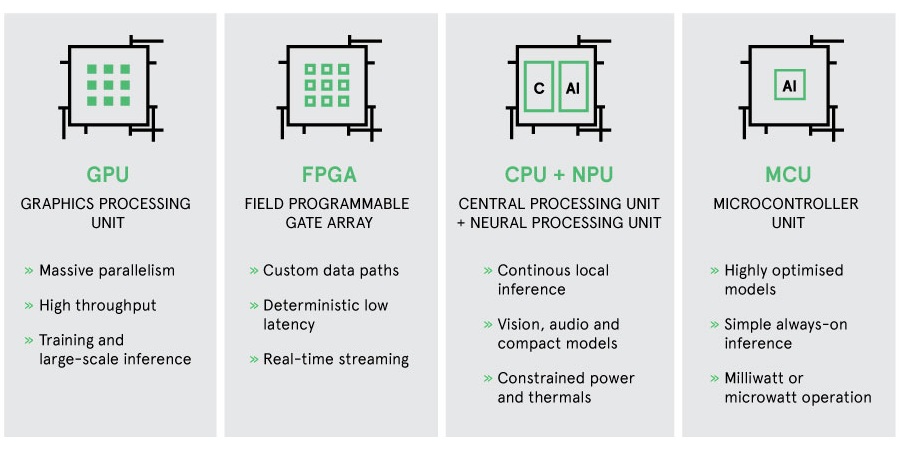
GPUs, FPGAs, CPUs + NPUs, and MCUs: benefits and applications compared
Read more about hardware options for AI applications in Michael Uyttersprot's article 'FPGA vs GPU vs CPU vs MCU – hardware options for AI applications'.
Power and Thermal Design as System Constraints
Power and thermal requirements emerge directly from the application and the AI workload it must support; an industrial vision system, a mobile robot, or a battery-powered sensor each imposes distinct compute demands that define the model and, in turn, determine the hardware platform and its power profile.
A GPU-class system may operate at hundreds of watts, while an embedded SoC or CPU + NPU platform may operate at 10 to 50 watts, and microcontroller-based systems at milliwatts; these differences fundamentally change how power must be delivered and managed.
In many AI applications, power delivery must support sustained operation, as continuous inference workloads draw steady current and place ongoing demand on AC/DC and DC/DC conversion stages, placing conversion efficiency under focus. Even small losses in the range of 5-10% must be dissipated as heat and therefore accounted for early in the design.
Thermal behaviour is directly tied to this. While high-performance systems can rely on active cooling, including heat sinks, fan motor drivers, or liquid cooling, to maintain operating temperatures under sustained load, edge and embedded environments, where fanless or sealed designs are common, thermal dissipation is more constrained. This can ultimately limit processor selection, clock speeds, or duty cycles regardless of theoretical compute capability.
Power semiconductor choices across the power delivery network directly impact these thermal limits. Wide-bandgap technologies like Gallium Nitride (GaN) - used in compact DC/DC converters - and Silicon Carbide (SiC) - used in higher-power industrial power supplies - greatly improve power efficiency. Because they lose less energy as wasted heat, they help keep the surrounding processors and memory cooler, making thermal management much easier in sealed, fanless edge enclosures.
For engineers, especially as workloads evolve toward more persistent and stateful processing, sustaining performance within defined power and thermal limits becomes a primary design constraint rather than a secondary consideration.
From Model Design to Deployment Reality
Designing an AI model and deploying it within a real system are not equivalent tasks, and engineers often encounter barriers when results achieved in controlled environments are expected to translate directly into production, where hardware constraints, system integration, and operating conditions apply.
Models are often developed on high-performance GPU platforms with fewer constraints, but when transferred to embedded or edge systems, limitations in memory, compute, power, and thermal capacity become immediate. Typical mistakes include underestimating these constraints early in development, which can require rework through further quantisation, pruning, or architectural simplification, potentially affecting accuracy or functionality.
Integration introduces additional complexity, and it is easy to underestimate how tightly AI models are coupled to the surrounding system. Models depend on continuous data from sensors, interaction with control systems, and communication across networks, creating requirements around I/O bandwidth, protocol selection, synchronisation, and fault handling that must be addressed alongside model performance.
Translating AI Requirements into Deployable Systems with Avnet Silica
Addressing these challenges requires understanding how model requirements map to a complete hardware architecture, including compute platforms, memory and storage, power delivery, connectivity, and thermal design. This is not a single decision point, but a set of interdependent trade-offs, where choices in one domain directly affect constraints in another as systems move from development into deployment.
Avnet Silica supports this process by understanding AI workloads and how model characteristics such as size, precision, data flow, and latency requirements translate into hardware constraints in real systems. Combined with a broad ecosystem of semiconductor suppliers, including companies such as AMD, DEEPX, NXP, Renesas, STMicroelectronics, Microchip, onsemi, and Micron, this spans MCUs, MPUs, SoCs, FPGAs, and dedicated AI accelerators, alongside complementary technologies across memory, storage, high-speed connectivity, and power, including advanced power technologies like SiC and GaN.
By combining access to this supplier ecosystem with system-level engineering expertise, Avnet Silica helps engineers avoid misalignment between model requirements and hardware capabilities, translate AI objectives into practical system decisions, reduce redesign risk, and accelerate time to production.
Working on an Artificial Intelligence project?
Our experts bring insights that extend beyond the datasheet, availability and price. The combined experience contained within our network covers thousands of projects across different customers, markets, regions and technologies. We will pull together the right team from our collective expertise to focus on your application, providing valuable ideas and recommendations to improve your product and accelerate its journey from the initial concept out into the world.