
Superfast switching with soft recovery
Nexperia’s NextPowerS3 MOSFETs are Safe, Reliable and Efficient.
A high-performance 25V, 30V and 40V MOSFET platform incorporating Nexperia’s unique superjunction technology, with the copper-clip LFPAK package to deliver low RDS(on), as well as demonstrating a continuous current capability up to 380A.
Nexperia offers a “no compromise” parameter selection. Until now power engineers have had to choose between competing MOSFET capabilities, such as low RDS(on) vs. low QG(tot), or fast-switching vs. low spiking, ultimately leading to products that are compromised in terms of efficiency, size, and cost. NextPowerS3 is not the case. Managing to achieve a balance between all key parameters.
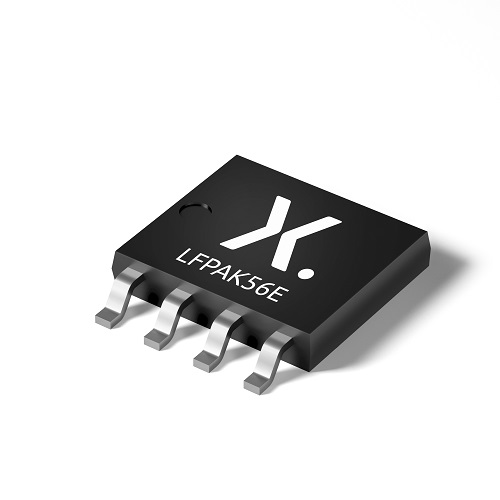
The NextPowerS3 family spans across the LFPAK package range (LFPAK33 (SOT1210), LFPAK56 (SOT669), LFPAK56E (SOT1023) and LFPAK88 (SOT1235)) which are completely free of wirebonds, meaning they deliver a competitive RDS(on) (industry best in 25V) as well as low Rth, low inductance and excellent board level reliability.
Suitable for a wide range of applications including high-efficiency power supplies for telecoms and cloud computing: Or-ing, hotswap synchronous rectification, motor control and battery protection.

- NextPowerS3
- NextPower 80V/100V
NextPowerS3
Key features
- Balanced RDS(on) and Qg for class leading efficiency.
- Unique Schottky Plus technology delivers low spiking without compromising efficiency or IDSS leakage.
- High reliability LFPAK packages. Copper clip, solder die attach and qualified to 175 C.
- 4x SOA capability compared to leading competitors.
Technology advantage
- Low RDS(on) MOSFETs minimize conduction (I2R) losses, this is especially important at high loads.
- Low Qg MOSFETs minimize switching losses, this is important at peak efficiency and in higher frequency designs
- Figure of Merit ( FoM ) is calculated as the product of the RDS(on) and Qg. NextPowerS3 MOSFETs exhibit low FOMs, indicating performance excellence.

Applications
- Low RDS(on) types for power ORing , hotswap and soft
- DC to DC solutions for server and telecoms.
- Voltage regulator modules (VRM).
- Point of Load ( PoL )
- Secondary side synchronous rectification.
- Brushed and brushless motor control.
NextPowerS3 portfolio
| Device (LFPAK56/E) |
VDS [max] (V) | RDS(on) [max] @ VGS = 10 V (mΩ) |
Tj [max] (°C) | ID [max] (A) |
|---|---|---|---|---|
| PSMNR51-25YLH | 25 | 0.57 | 175 | 380 |
| PSMNR60-25YLH | 25 | 0.7 | 175 | 300 |
| PSMNR58-30YLH | 30 | 0.67 | 175 | 380 |
| PSMNR70-30YLH | 30 | 0.82 | 175 | 300 |
| PSMN0R9-30YLD | 30 | 0.87 | 150 | 300 |
| PSMN1R0-30YLD | 30 | 1.02 | 175 | 300 |
| PSMN1R2-30YLD | 30 | 1.24 | 175 | 250 |
| PSMN2R4-30YLD | 30 | 2.4 | 175 | 100 |
| PSMNR90-40YLH | 40 | 0.94 | 175 | 300 |
| PSMN1R0-40YLD | 40 | 1.1 | 150 | 280 |
| PSMN1R4-40YLD | 40 | 1.4 | 175 | 240 |
| PSMN1R0-40YSH | 40 | 1 | 175 | 290 |
| PSMN1R5-40YSD | 40 | 1.5 | 175 | 240 |
| PSMN1R7-40YLD | 40 | 1.8 | 175 | 200 |
| PSMN1R9-40YSD | 40 | 1.9 | 175 | 200 |
| PSMN2R0-40YLD | 40 | 2.1 | 175 | 180 |
| PSMN2R2-40YSD | 40 | 2.2 | 175 | 180 |
| PSMN2R5-40YLD | 40 | 2.6 | 175 | 160 |
| PSMN2R8-40YSD | 40 | 2.8 | 175 | 160 |
| PSMN3R2-40YLD | 40 | 3.3 | 175 | 120 |
| PSMN3R5-40YSD | 40 | 3.5 | 175 | 120 |
| Device (LFPAK88) |
VDS [max] (V) | RDS(on) [max] @ VGS = 10 V (mΩ) |
Tj [max] (°C) | ID [max] (A) |
|---|---|---|---|---|
| PSMNR70-40SSH | 40 | 0.7 | 175 | 425 |
| PSMNR90-40SSH | 40 | 0.9 | 175 | 375 |
| PSMN1R0-40SSH | 40 | 1 | 175 | 325 |
| Device (LFPAK33) |
VDS [max] (V) | RDS(on) [max] @ VGS = 10 V (mΩ) |
Tj [max] (°C) | ID [max] (A) |
|---|---|---|---|---|
| PSMN1R5-25MLH | 25 | 1.8 | 175 | 150 |
| PSMN1R6-30MLH | 30 | 1.9 | 175 | 160 |
| PSMN1R8-30MLH | 30 | 2.1 | 175 | 150 |
| PSMN3R3-40MLH | 40 | 3.3 | 175 | 118 |
| PSMN3R3-40MSH | 40 | 3.3 | 175 | 118 |
| PSMN4R3-40MLH | 40 | 4.3 | 175 | 95 |
| PSMN4R3-40MSH | 40 | 4.3 | 175 | 95 |
| PSMN5R0-40MLH | 40 | 5.0 | 175 | 85 |
| PSMN5R0-40MSH | 40 | 5.0 | 175 | 85 |
| PSMN6R7-40MLD | 40 | 6.7 | 175 | 50 |
| PSMN6R7-40MSD | 40 | 6.7 | 175 | 50 |
| PSMN8R5-40MLD | 40 | 8.5 | 175 | 50 |
| PSMN8R5-40MSD | 40 | 8.5 | 175 | 60 |
NextPower 100V power MOSFETs
Market leading Low Qrr performance feature high 175°C rating
Nexperia’s NextPower 100V family of power MOSFETs devices improve switching efficiency, increase reliability and reduce EMI.
With 50% lower RDS(on) and strong avalanche energy rating, they are ideally suited for power supply, telecom and industrial designs, especially suiting USB-PD Type-C chargers and adaptors and 48 V DC-DC adaptors.
The devices feature low body diode losses with Qrr down to 50 nano-coulombs (nC) - resulting in lower reverse recovery current (IRR), lower voltage spikes (Vpeak) and reduced ringing which allows for further optimized dead-time.
The NextPower 100V MOSFETs are available in three packages: TO220 and I2PAK thru-hole devices, and the widely acclaimed LFPAK56 package (SMT). All package variants feature Tj(max) of 175°C, and fully meet the extended temperature requirements of IPC9592, making NextPower 100V MOSFETs especially suitable for telecom and computing applications.
Design benefits
- Low Qrr for higher efficiency and lower spiking
- Low QG × RDS(on) FOM for high efficiency switching applications
- Strong avalanche energy rating (Eas)
- Avalanche rated and 100% tested
- Ha-free and RoHS compliant LFPAK56 package
- Wave solderable LFPAK56 package
Key technical features & portfolio
- New 100V portfolio
- Packages : LFPAK56 (SOT669) and LFPAK56E (SOT1023)
| Portfolio | Voltage | RDS(on) [max] @ VGS = 10 V (mΩ) |
Package |
|---|---|---|---|
| PSMN6R9-100YSF | 100V | 7 mΩ | LFPAK56 |
| PSMN8R7-100YSF | 100V | 9 mΩ | LFPAK56 |
| PSMN011-100YSF | 100V | 10.9 mΩ | LFPAK56 |
Functions & applications
- Synchronous rectifier in AC/DC & DC/DC
- Primary side switch 48V DC/DC
- BLDC motor control
- USB PD adapters & chargers
- Full bridge and half bridge applications
- Flyback and resonant topologies
Available packages
| LFPAK56 (SOD669) | LFPAK56E (SOT1023) |
|---|---|
 |
 |
| 5.0 x 6.0 x 1.0 | 5.0 x 6.0 x 1.0 |

Links & Documents |
Have a question?Get in touch: |